
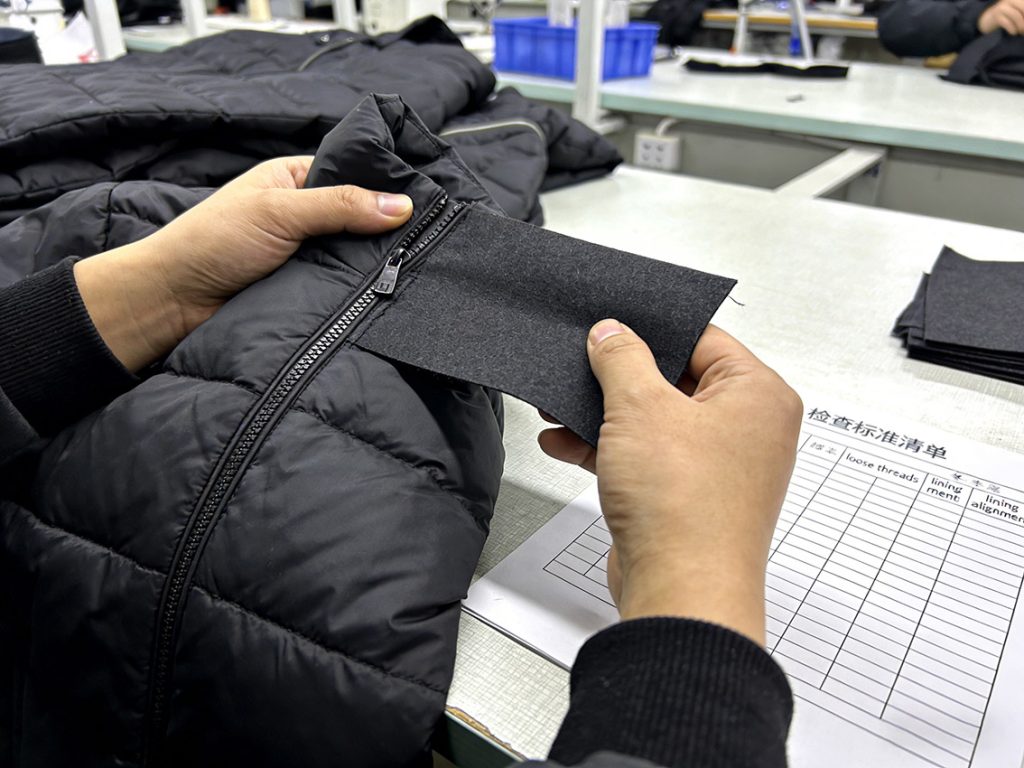
Achieving consistent quality in a Winter Apparel Series requires a complete system, not just skilled sewing. This structured approach safeguards your brand from costly returns and protects customer satisfaction. Let us outline our managed quality process, which ensures excellence from the production floor to the shipping door.
1. Proactive Monitoring with In-Line Checks
Quality control begins actively during production. Supervisors monitor each sewing station to identify issues immediately. They look for problems like skipped stitches or uneven tension. For quilted items, they also verify stitch consistency and pattern alignment. This early detection prevents minor errors from moving further down the line. Consequently, it saves considerable time and reduces material waste, making early correction far more efficient than repair at a later stage.
2. The Critical First Assembly Inspection
Following initial assembly, each garment undergoes a detailed preliminary check. Technicians perform this step before adding final details like zippers or linings. They verify that all main seams are secure and that all panels are correctly aligned. Additionally, they ensure any insulation or padding is distributed evenly. This early review successfully catches construction flaws before later finishing steps could conceal them.
3. Comprehensive Post-Assembly Inspection
Once fully assembled, every piece receives a thorough final inspection. Inspectors compare each garment directly to the approved production sample. The checklist for this stage is extensive. It includes examining seam strength and stitch density. Furthermore, technicians test every zipper, snap, and button for smooth function. For winter items, special attention goes to checking insulation for cold spots and verifying lining alignment. Finally, they remove any loose threads and assess the garment’s overall shape.
4. Functional Testing for Real-World Performance
Beyond visual checks, winter apparel must perform in real conditions. Therefore, random samples from each batch undergo functional tests. These tests may include checking the water resistance of outer shells and assessing seam tape durability. This crucial step verifies that the garment will reliably meet the customer’s practical needs.
5. Precision Finishing and Professional Pressing
Presentation significantly impacts the customer’s first impression. Winter coats and jackets require careful finishing. Our operators use professional steaming and pressing equipment to remove wrinkles and set seams. This process gives each garment a crisp, retail-ready appearance. Moreover, trained staff ensure a consistent look across all sizes and styles, directly enhancing the unboxing experience.
6. Strategic and Protective Packing
We prepare every shipment with its final destination in mind. Initially, each garment gets placed in a protective poly bag to guard against dust and moisture. Then, items are folded neatly using tissue paper or cardboard inserts to prevent deep creases. For shipping, we select strong, double-walled cartons that are clearly labeled with your PO and style information. This careful packing method prevents damage during transit and simplifies warehouse receiving.
7. Final Audit and Documentation
Before sealing any carton, we perform a final packing audit to verify contents against the packing list. We also document the entire process with detailed shipping manifests and photos. This practice ensures total transparency and provides a clear record for your logistics team.
Conclusion: Building Trust Through Consistent Quality
A rigorous quality system is a direct investment in your brand’s reputation. It ensures customers receive durable, perfect winter gear, which builds loyalty and reduces support costs. We apply these meticulous processes to every Winter Apparel Series, safeguarding your brand reputation from stitch to shipment.